“Perseverare autem diabolicum” or thoughts on blackening Ash

Posted May 22, 2013 by D.B. Laney
Categories: Uncategorized

Tags: , ,

In my last post I discussed the difficulty of trying to carve ash.  Hey, don’t get me wrong.  Ash is a wonderful material.  Right now it’s plentiful and it’s cheap.  It turns very well.  And, properly finished, it is a very attractive wood that can be used (nearly) interchangeably with other ring porous species.  But, as I recently testified, you’d have to be real masochist to want to carve it on a regular basis.  Walnut or mahogany,  it is not!  You’re probably not going to see many highly carved pieces in ash.

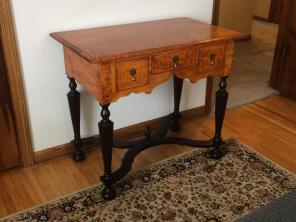
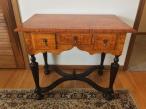
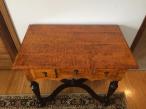
Another real challenge with ash, is ebonizing it.  Anyone who is familiar with this blog knows that I am keenly interested in traditional finishing methods.  My ebonizing method of choice is iron and tannin.  While this method gives absolutely beautiful results on walnut, mahogany, cherry and a host of other woods, using it on ash has always been a real challenge.  In fact, I have “stooped” to the use of aniline dye and the “wiped, thinned paint” method on more than one occasion in the past.  But after stumbling across an article by Brian Boggs on the subject, I decided I’d try it one more time; ergo:  Preserverare autem diabolicum.  (This is very similar to the definition of insanity being the act of repeating a behavior with the expectation of a different result.)  The subject product is the coffee table I’m building for our living room.  Hope it works (remembering that ash offers pretty good heating value).

Ash is not high in tannin so, following Boggs’ suggestion, I mixed up a batch of “oak bark tea”, 1 tbs/pint water.  In this case, I used a bark powder product used in leather tanning.  In the past, I’ve used oak bark, leaves and oak galls (which, I believe, have the highest concentration of tannin) to brew the tea.  (I have heard of folks brewing a very “thick” tea from regular black tea, as well.)  I brushed the surface of the table, liberally.  The “tea” deepened the color of the ash after drying.

Copy (1) of 005

Next, I prepared a solution of iron acetate.  This was made by simply soaking some steel wood in white vinegar for a couple of days.  (Note:  a gas is produced in this process, so don’t cork up the jar too tightly, lest you be injured by potential flying shards of glass.  Put a rubber glove over the jar, or use a plastic container.)  I’ve heard of other folks using iron (ferrous) sulfate  which can probably be found in garden stores.  What you’re looking for is iron to react with the tannic acid provided by the tannin tea.

Copy (2) of 007

I “decanted” the iron acetate mixture, through some cheese cloth and was left with a grayish, yellowish, greenish fluid, rich in iron.

Copy (1) of 009

Then I brushed the surface with the iron acetate solution, liberally.  This is a messy process.  So, unless you want  black marks all over the floor, put down a dropcloth.

Copy (2) of 010

After this application had dried completely, I noticed the chemical process had not taken effect in certain areas of the surface.  This was in the areas of the porous rings.  (This is the problem when trying to ebonize ash.)  I remembered that Boggs had said that he had put another coat of the “tea” on in order to get more tannin on the surface to react with any free iron.  So, I figured that if one coat would help, two coats would work even better.  I was sure that there would be plenty of tannin.  After the second coat of tea was dry,  I hit the table with another coat of iron acetate.  I had my evening scotch, then went off to bed.  When the morning arrived, I was startled by what I encountered.  A deep brown precipitate had formed.  (A light precipitate is normal, but grey or black not brown.)

Copy (1) of 001

It turns out that this was not a huge problem.  After some light buffing with a “scotchbrite” pad, a lovely “warm” black color appeared.  However, the area of the porous rings still had not been uniformly affected by the process.  But with the judicious use of some “black oil” (lamp black in boiled linseed oil) a uniform look was achieved.

Copy (2) of 005

Three or four coats of rubbing varnish will produce a finish of incredible depth and durability.

So…what is the upshot of all this Alchemy?  If you’re “into” historic finishing techniques, you’ll enjoy using this one.  But as a commercial finish for anything made from ash, I’d have to recommend against it. What you’d save in product cost, is more than offset by the amount of labor involved.  Any client who wants something built from ash will, very likely, not see the value of this finishing method.  Use a thinned alkyd enamel or black milk paint, throw a couple of coats of oil or spirit varnish on it, and collect your payment.  However…if you’re working with cherry or walnut and you need some ebonized surfaces…

Errare Humanum Est….

Posted May 18, 2013 by D.B. Laney
Categories: Uncategorized

Tags: , , , ,

perseverare autem diabolicum. 

So… you make one mistake, you’re just human.  But, if you continue to do the same thing, the Devil’s in your head, or you’re just plain stupid.

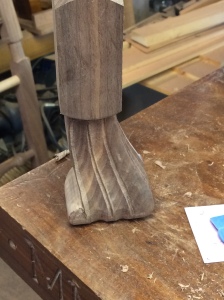
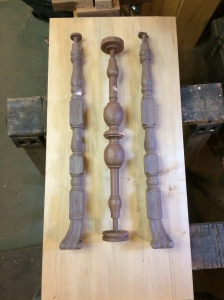
The last time I carved in Ash, I make a solemn promise to myself that I wouldn’t do it again.  But hey, I never claimed to be the “brightest penny in the purse”.   Recently I decided to replace our old “coffee” table with something a little more..uh, unusual.  The goal was a table that had some period influence, but was rather unique.  I decided to do a “bandy-legged” design that harkened back to the Oriental origins of much of what we recognize as late 18th century English and American furniture.  I decided to do an ebonized finish, which meant I wouldn’t need to use the best of “show” woods.  What did I have at hand in large squares?  You guessed it, baseball bat material!  Here we go again.

Copy (1) of 007

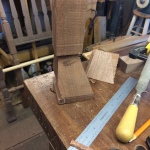
After sharpening up the tools, I went to work.  There were moments that I wished for a power carver or a 4″ grinder.  My design has a very curved “ankle”.  The shape is easy to draw, but presents some real challenges when you’re carving it with conventional tools.  (Carving against the grain in Ash just isn’t going to happen, trust me.)  After hours spent cursing under my breath (and sometimes out loud), the task was completed.

Copy (1) of 010

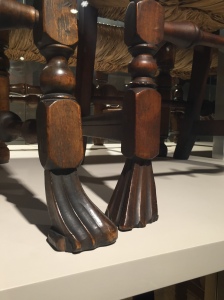
In the Oriental tradition, these legs would be in the “Dragon’s foot” family.  Whatever they are, the table frame looks like it’s going to chase me right out of the workshop.

Now to turn it black and “top it off” appropriately.

Not your usual bench chisel

Posted May 12, 2013 by D.B. Laney
Categories: Uncategorized

Tags: , ,

“Pedestrians” (non-woodworkers) might assume that slicks are for chopping holes in preparation for the next ice fishing tournament.  Most woodworkers identify slicks with timber framing and boat or ship construction.  It’s not unusual that, upon seeing a slick,  people will feel compelled to tell the story of how their Uncle Joe lost his toe when his slick became separated from its handle.  But the slick is a paring chisel, albeit a very large paring chisel.  The slick’s design does vary somewhat from most paring chisels, in that it usually has a “thickened spine” and it is slightly curved in its length.  Also, most old slicks have a slightly cambered cutting edge.

A 3" slick compared to a 2" socket firmer chisel

A 3″ slick compared to a 2″ socket firmer chisel

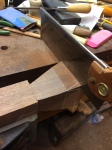
Most furniture builders would not consider a slick the type of tool that would lend itself well to their endeavor.  But a few days ago, I needed to trim some leg posts flush with the aprons of a “bandy-legged” table I’m working on.  Anyone who has done this task will agree that it is difficult due to the potential of  tear out and edge breakage.  So I decided to take a little different approach.  Knowing that slicks are used to trim tenons, I decided to see how a slick would do on the leg posts.  Surprisingly, it worked very well.

115

Let me say, without hesitation, that a slick, like any other edge tool, needs to be razor sharp to work as it is intended.  I was careful to pare with the grain and at an acute diagonal, much greater than the above illustration would indicate.  Taking narrow, adjacent cuts seemed to work best and I took extra care when nearing the arris of the post.  A little planing and scraping was still required.  But, all in all, the slick worked very well in removing the bulk of the stock that needed to be trimmed away.

So before you start clearing your drive after the next ice storm with that old slick you picked up at someone’s garage sale, consider the possibilities…

A thing of beauty is a joy forever

Posted April 1, 2013 by D.B. Laney
Categories: Uncategorized

Tags: , , ,

I’ve learned over the years that beauty can be found in the most unexpected places.  But most of my friends and acquaintances would probably agree that a sawhorse would not usually be held up as an object of adoration.  Well, unless you’re already familiar with the work of Master Carpenter Louis Mazerolle and the French journeyman carpenters of the late 19th and early 20th century, get ready to change your view.  Erase that image of the paint stained, cut up,” always needs to be tightened” thing you’ve been working with and feast your eyes.  Try not to go all agog…

arton1801-340x253

This is not simply a sawhorse.  In French it is called a treteau.  But a treteau is still a trestle.  But this is much more.  This is a laboratory in the practice of precision joinery and projected angle drawing that once understood, truly makes the journeyman a master.

The treteau above may well be the work of Mazerolle and Les Compagnons de Devoir.  But the trestle below is clearly Mazerolle’s design as is comes from his book, Traite Theorique et Pratique de Charpente:

2009_110 copy

This treteau is incredibly complex with diagonal bracing turned in such a way as to make it extraordinarily difficult to project.  I’m not sure if this version is joined or is fastened in some other manner, as I found this photo on Yahoo France.  I apologize for not being able to credit the craftsmen who completed this work.  It is amazing and I salute them.

Chris Hall of the Carpentry Way Blog, has completed a beautiful version of Mazerolle’s treteau.  He’s documented the process beginning in his January 2009 post.   Search for the posts marked Treteau.   Mr. Hall’s persistence, commitment to craftsmanship and his generosity in sharing his efforts is sui generis.  He also presents a Treteau dit Cadet, which is probably a better place to start for most mere mortals.

Another website which offers more discussion on the construction of a proper treteau is Association Bois de Brin.  Simply look for the plan d’un treteau.

We all need several good stout sawhorses.  And, building traditional treteaux is a way of perfecting joinery skills that are rarely used in the course of everyday furniture making or general woodworking.

BTW, when you visit The Carpentry Way, be sure to check out Chris’ gallery of work.  The guy’s good…very good.

Magnum Opus

Posted March 31, 2013 by D.B. Laney
Categories: Uncategorized

Tags: , ,

I love to build furniture.  My guess would be is that most woodworkers would put furniture building right up there at the top of the heap as an expression of skill and ability.  But after more than fifty years of experience in interior joinery and architectural carpentry, I might be inclined to take issue with that notion.

There are four words that will make me take immediate notice each time I hear them;  Post, beam, mortise, tenon.  Put together with the appropriate conjunction, these words describe a building process that has provided human beings around the world with structures that range from the lowly cow shed to the soaring cathedral.  Post and beam – Mortise and tenon.

Look at a pile of dismantled barn timbers and it suddenly becomes obvious.  This is complicated work.  This is work that requires skill and ingenuity.  This is work that requires mastery over subjects like geometry, as well as artistry.  This work requires physical strength, as well as intellectual stamina.  This is big work, magnum opus.  Heavy timber work.

1880-s-Hand-hewn-Beams_48723_1

Joined timber construction is amazingly strong and durable.  It utilizes a renewable resource that is, usually, at hand.  And, in many cases, salvaged timber will work as well as something fresh from the log yard.  Timbers can be sawn or hewed.  Many times an irregularly shaped timber will be used to take advantage of its natural strength.

The beauty of timber joinery cannot be overstated.  And I am struck by the tremendous similarities of Oriental and Occidental joinery.  While it’s true that the actual process of cutting the joints might be somewhat different, the results are usually the same.  The same types of scarf joint will be found in Japan, France and England.  However, if you watched these joints being made in these three areas, you’d be surprised at the difference in technique.  (There is no RIGHT WAY! – only the way that works for you)

from  "The Art of Japanese Joinery"

from “The Art of Japanese Joinery”

Anyone who has built furniture in a one man shop knows that it is a solitary job.  While solitude, in itself, can be spiritually rewarding, most of us need some peer contact on a regular basis.  Being complimented by a fellow carpenter is very much akin to being awarded an Academy Award.  Your peers know the level of your skill by their own experience.  And, the term Master Carpenter is more often an honorific conferred by brothers and sisters in craft, rather than a mere licensing document.

When the weather is cold and blowing, I’m content to be in the shop.  But as these spring days begin to warm, I realize that I miss the good natured banter of the jobsite, that has persisted through the ages.  And most of all, I miss working alongside carpenters doing heavy work.  I can think of nothing more rewarding.

From "Art de la Charpente", Diderot et D'alembert

From “Art de la Charpente”, Diderot et D’alembert

To learn more about Traditional Carpentry in Europe visit Charpentiers d’Europe dt d’ailleurs.

To download a very good, free booklet on historic timber framing in the United States, go to www.ncptt.nps.gov/wp-content/uploads/2004-08.pdf

If you think you’re a good carpenter, visit Chris Hall’s blog.  But be warned.  Chris’ blog is serious stuff, for serious carpenters.

The “Ace” of All Trades

Posted March 27, 2013 by D.B. Laney
Categories: Uncategorized

Tags: , ,

One hundred years ago, when my Grandfather was just finishing his apprenticeship, most of the world’s population still lived in rural surroundings.  Unless the young craftsman was headed for the city, where specialization was common, he was likely to be engaged in all types of work that were based on working with wood.

On any given day the rural carpenter might lead a team of neighbors in building a barn or house, repair a wagon, build a gate, create a dower chest, spend time above or within the saw pit.  He might build falsework to support the masonry on the new bridge across the creek.  He might build a new sluice at the mill or provide a new bull gear.  In short, the rural carpenter was a central figure in the community.  His importance to rural life cannot be understated.  The master carpenter was surely seen as a steward of arcane knowledge that was vital to the general well-being of the community.  And as I heard more than once, “sure, wasn’t Jesus Christ, his’self, a carpenter?  And St. Joseph, as well”.

Here are a few reminders of what a carpenter’s day might have included in years gone by.

One Tough Cookie

Posted March 21, 2013 by D.B. Laney
Categories: Uncategorized

Tags: ,

Today it’s not uncommon to see women participating in all of the building trades, in every part the western world.   But at the beginning of the twentieth century it would have been rare to see a woman working as a professional trades person.  One notable exception was Juliette Caron, born in Oise, France in 1882.

Here, Juliette demonstrates the use of the bisaigue, the traditional mortising tool that is emblematic of French Carpenters

Here, Juliette demonstrates the use of the bisaigue, the traditional mortising tool that is emblematic of French Carpenters. The caption notes that she is the only woman in France working at the job of carpentry (presumably circa 1900)

Anyone who has ever drilled out a mortise with a “tee-handled” auger will appreciate just how strong Mademoiselle Caron must have been.

The look of sheer determination

The look of sheer determination

Today, even with the assistance of hydraulic cranes and any number of other labor saving devices,  the work of the timber framing carpenter is physically demanding.  In 1900, while the use of steam powered machinery was common,  most of the lifting and toting was done by the workman.  Wooden cranes, driven by windlasses or blocks and tackle were powered by crews of carpenters working together.  But individual frame members would often be carried up ladders, many times to quite lofty heights.  Note the size of the beam that Juliette has parked on her shoulder.  This is a formidable lady.

A lady to be reckoned with

A lady to be reckoned with

One can only imagine how difficult it was for a young woman to prove herself to a  ”gang” of “old hand” carpenters in the early 1900′s.  In 2013 that can still be a difficult task, even with the legislative and cultural advances that have been made.  I think the lesson that people like Juliette Caron teach us is, that it’s not important “who’s” doing the work, but that the work gets done, correctly.

Remember, Ginger Rogers did everything that Fred Astaire did.  But she did it backwards and in high-heels.

Learn more about traditional carpentry in France at Charpentiers d’ Europe et d’ailleurs.  Use the English version, if your French is a little rusty.


Follow

Get every new post delivered to your Inbox.

Join 32 other followers